🌀 It’s the beginning of the year. Volumes are down. Sales are sluggish. Chinese New Year has slowed imports… and money feels tight.
That’s when many companies instinctively say: “Let’s tighten the belt—no special projects right now.”
But what if I told you… 👉 This is actually the perfect time for projects.
Why?
🌸 Because springtime is spring cleaning time. And your business processes need a refresh just as much as your closet does.
Now is the time to:
Dust off that old payables process and streamline it.
Finally run that ICP (Ideal Customer Profile) workshop.
Revisit the workflows that have been “good enough” for too long.
Spring cleaning isn’t just for homes—it’s for organizations too. 🧼 Clean it up. 🔄 Cycle it back in. 💡 Get ready for the rebound with systems that actually support your growth.
To align sales, operations, and finance on the ideal customer profile (ICP) for your freight forwarding business. This workshop will help your team focus on profitable, long-term relationships instead of chasing low-value leads.
Duration: 2.5 – 3 hours
Facilitator:
Recommended: Sales Director, VP of Sales, or an External Consultant (e.g., ALL2S Consulting)
Participants:
✅ Sales Team ✅ Operations & Customer Service ✅ Finance & Credit ✅ Leadership/Strategy Team
🔹 Be strategic on who represents each group. You want a good mix of experience—not everyone has to be a senior manager. The voice of desk operations must be adequately represented, or process needs to be in the room to ensure realistic execution and support alignment.
📍 Step 1: Pre-Workshop Data Collection (1 Week Before)
🎯 Goal: Establish a baseline understanding of your current customer landscape.
✅ Pull key data from CargoWise or internal systems:
Number of active customers (past 12 months)
Total shipments by customer, trade lane, and vertical
Top trade lanes (volume & revenue)
Key industry verticals served
Profitability by: Customer Trade Lane Vertical
📌 Why This Matters: Many companies assume they serve all industries equally, but data often reveals certain lanes and verticals are far more profitable than others. This pre-work ensures we focus the conversation on facts, not assumptions.
🚨 If you need help analyzing your CargoWise data, ALL2S Consulting can assist in bringing your current state into focus.
📍 Step 2: Workshop Kickoff (15 Minutes)
🎯 Goal: Set expectations and outline the importance of defining the right customer.
✅ Facilitator opens with:
Why defining an ideal customer profile (ICP) is critical.
The impact of bad-fit customers on profitability, efficiency, and team morale.
The cost of onboarding a new customer ($400+ on average with minimal initial profit).
The importance of playing the long game—hunting caribou, not rabbits.
💡 Key Message: In a time where costs are being monitored like a hawk, we cannot afford to waste resources on low-value leads.
📌 Time Management Tip: I was once told a task will fill as much time as you give it. If you schedule 3 hours, it will take 3 hours. If you give it 3 days, it will fill 3 days. This process does not have to eat up a ton of time. If you complete your pre-work (i.e., pull the data, analyze it, and provide it to the workshop team in advance), you can have very focused conversations that don’t take days—but instead just hours.
Especially with the senior leaders in the room, it is hard to pin them down, and they often cannot afford to spend days in workshops. One way to keep things on track is to have a timekeeper who is very draconian about it—when time’s up, time’s up. If people know you are serious about time limits, they will often cut out extraneous discussions that pull the group off-task.
⏳ So, make sure you have a timer AND a timekeeper with a strong cut-off game!
📌 Documentation Tip: With all the good insights coming from this workshop, you need to make sure you have a note keeper to document everything. There are templates available to recap and codify what has been agreed upon. If you need one, I have them—and I’m not too stingy to share. Reach out, and we can discuss what you will come to find as a significant step in the right direction toward moving your organization into better strategic alignment.
Often, when workshops are scheduled, people roll their eyes and believe they are a waste of time. But making sure the efforts are documented and finalized—distributed by senior management with the full weight of enforcement—will ensure: ✅ A happier sales team because they know who to target and where to hunt. ✅ A more focused operations team because they won’t be spread too thin across too many different types of customers. ✅ A satisfied finance team because this is a proactive way to manage the risk of bad debt and identify opportunities to maximize profitability.
📍 Step 3: Identifying the Ideal Customer Profile (60 Minutes)
🎯 Goal: Define what makes a high-value, long-term customer and what to avoid.
✅ Break into groups & discuss:
What industries/verticals align best with our expertise?
Which trade lanes or logistics models do we excel at?
What characteristics make a high-value, long-term customer?
What red flags indicate a bad-fit customer?
Are there specific Incoterms, payment structures, or shipment patterns that don’t work for us?
💡 Red Flag Alert: Customers who “date” forwarders—jumping around looking for the lowest price—are risky. You want to be the marrying kind and play the long game with committed partners.
🎯 Goal: Create a clear ICP to guide sales, marketing, and operations.
✅ Outline the Ideal Customer Profile: ✔ Core Trade Lanes & Vertical Focus ✔ Typical Shipment Types & Volumes ✔ Preferred Customer Behaviors (long-term relationships, contract shipping, etc.) ✔ Financial & Operational Fit (payment terms, creditworthiness, service expectations) ✔ Red Flags to Avoid
📌 Deliverable: A 1-page Ideal Customer Profile (ICP) shared across departments.
📍 Step 5: Aligning Sales & Lead Generation (30 Minutes)
🎯 Goal: Ensure sales teams are targeting the right customers.
✅ Key Discussion Points:
How do we qualify leads before investing resources?
What messaging attracts the right customers?
How do we implement a lead scoring system?
How do we create a smooth handoff process between sales & operations?
💡 Sales Tip: Don’t send your hunters to bring home rabbits when you need caribou. 🦌
📍 Step 6: Review & Optimize (Final 15 Minutes)
🎯 Goal: Plan how to keep refining your ideal customer profile over time.
✅ Quarterly Strategy Check-In:
Review new customers onboarded – do they fit the profile?
Identify misaligned customers and adjust strategy accordingly.
Adjust target markets or service offerings based on profitability trends.
Gather feedback from finance, operations, and customer service to refine criteria.
💡 Big Picture: The freight forwarding business thrives on long-term, strategic relationships. Saying “no” to the wrong customers today will make space for high-value customers tomorrow.
🚀 Final Takeaway: Focus on the Right Customers, Not Just More Customers
✅ Hold regular strategic conversations to refine your customer criteria. ✅ Align sales, operations, and finance to avoid misaligned leads. ✅ Always play the long game—short-term wins with the wrong customers will hurt long-term profitability.
🚨 Need expert help to analyze your CargoWise data and structure your ideal customer strategy? 📢 ALL2S Consulting is here to help!
🔗 Reach out today and let’s get your business on the path to strategic, profitable growth.
Use this checklist to guide strategic discussions on identifying the ideal customer for your freight forwarding business. Align operations, sales, and service models to maximize profitability, efficiency, and long-term relationships.
1️⃣ Industry & Vertical Fit
✔ Does the customer operate in an industry we specialize in (e.g., Pharma, Automotive, Furniture, Electronics, Fashion, etc.)? ✔ Does their cargo type align with our expertise (e.g., general cargo, perishables, hazardous, oversized, temperature-controlled, high-value goods)? ✔ Do they require specialized logistics solutions (e.g., temperature control, white-glove service, customs brokerage, warehousing, consolidation services)?
💡 Anecdote: The best customers are those whose shipments naturally align with what we already do well. If you specialize in furniture, a pharmaceutical client might not be a great fit.
2️⃣ Trade Lane & Network Alignment
✔ Do they regularly ship along our key trade lanes? ✔ Can their shipments contribute to our existing LCL (Less than Container Load) or air cargo consolidations? ✔ Do they require intermodal or multimodal solutions that match our service offering?
💡 Anecdote: A customer who regularly ships from Germany to the U.S. is a perfect fit if we have established weekly consolidations on that route. Conversely, a company shipping once a year from a remote location might not justify the operational lift.
3️⃣ Long-Term Value vs. One-Off Transactions
✔ Does this customer have the potential for repeat business, or are they a one-time shipper? ✔ Are they willing to build a long-term relationship instead of just shopping for the lowest rate? ✔ Do they show a pattern of jumping from forwarder to forwarder?
💡 Anecdote: On average, it costs $400 to onboard a new customer. Between setting up credit, vetting compliance, and establishing operational workflows, the first few shipments often yield little to no profit. If they aren’t committed to a long-term relationship, they could end up costing more than they bring in.
💡 Red Flag: Customers who “date” forwarders—jumping around looking for the lowest price—are risky. You want to be the marrying kind and play the long game with committed partners.
4️⃣ Financial & Operational Readiness
✔ Can they meet our standard payment terms? ✔ Do they have a reliable track record of paying invoices on time? ✔ Are their Incoterms aligned with our risk tolerance and financial policies? ✔ Does their operational complexity match our capacity and expertise?
💡 Anecdote: It’s tough to turn down revenue, but a bad-fit customer creates more headaches than profits. A customer with tight cash flow or a history of disputed invoices is a finance nightmare. Sales teams may land the deal, but finance and operations have to live with the fallout.
5️⃣ Customer Expectations & Service Model Fit
✔ Do they require a high-touch service model (hands-on customer support, dedicated account management)? ✔ Are they comfortable with our existing technology solutions (track-and-trace, CargoWise integration, digital quoting)? ✔ Do they expect service levels that we can realistically deliver?
💡 Anecdote: A customer expecting 24/7 support, hyper-fast transit times, and VIP treatment—but only shipping once a quarter—may drain resources disproportionately. Aligning expectations with service reality prevents frustration on both sides.
6️⃣ Growth Potential & Strategic Alignment
✔ Is this customer positioned for growth that could increase their shipping volume over time? ✔ Can we offer additional services (warehousing, customs brokerage, distribution, supply chain consulting)? ✔ Are they in a sector we want to expand into?
💡 Anecdote: The right customers grow with you. A small business today could become a major shipper tomorrow. But not every lead is worth the chase—if they’re too small, too irregular, or too outside our core competency, they can drain resources instead of driving profits.
7️⃣ Sales & Lead Qualification
✔ Does our sales team know exactly who to target? ✔ Are we guiding sales toward high-value customers instead of just volume? ✔ Do we have a clear customer profile to qualify leads before investing time and resources?
💡 Anecdote:Don’t send your hunters out to bring home rabbits when you want caribou. Sales should be laser-focused on customers that fit the strategic model. Chasing unqualified leads creates friction between sales, operations, and finance. The wrong customers cost more than they’re worth.
Key Takeaways & Action Plan
✅ Does this customer align with our expertise, trade lanes, and service model? ✅ Are they a long-term relationship or just a short-term transaction? ✅ Are they financially and operationally viable? ✅ Can we scale with them, or will they drain resources? ✅ Does our sales team have clear guidelines on who to pursue?
This checklist helps ensure freight forwarders invest in the right customers, build profitable relationships, and avoid costly misalignments.
I’ve spent a lot of time talking about expenses, efficiencies, and risk management, but today, let’s talk about something just as critical—CUSTOMERS.
We all know it costs money to get customers—a lot of money. You need sales teams, commission structures, operational support, and a whole infrastructure just to onboard and retain them. The reality is:
✅ Your business exists to sell—goods, services, or both. ✅ Not all customers are good customers, especially in service industries. ✅ Acquiring the wrong customers can be an expensive mistake.
I’ve worked in two very different environments: 1️⃣ One that strategically defined its ideal customer, understood its niche, and had the courage to say no when a prospect didn’t fit. 2️⃣ One that took any customer—because, hey, “there’s no such thing as a bad customer,” right?
But here’s the thing: It’s not about “bad” customers—it’s about aligned customers.
📌 Customer acquisition isn’t just about volume; it’s about value. If you’re in freight forwarding, for example, competing on price is a race to the bottom. Instead, focus on differentiation—trade lane specialization, industry expertise, and value-added services.
📌 Farmers & Hunters in Sales 🌱 Farmers nurture and grow existing accounts—because it’s always cheaper to retain a customer than to acquire a new one. 🎯 Hunters should target the right customers—the ones that fit your strategic goals, industry verticals, and operational strengths.
And of course, let’s talk RISK (because you know I can’t resist 😉): ⚠️ Extending credit to the wrong customer? That’s a bad debt waiting to happen. ⚠️ International trade compliance? Know your customer or risk seized goods and hefty fines. ⚠️ Overextending operational capacity? Catching the “big kahuna” means nothing if your team can’t support them.
Let’s Face It – It’s Hard to Turn Away Customers
In difficult times, it’s tempting to accept any customer—even those who don’t fit your profile. But playing devil’s advocate, catering to misaligned customers strains your resources and takes your team’s focus off the prize.
📊 How to Start Defining Your Ideal Customer? If you’re not there yet, let me help you. Start first with your own in-house data—your operating system should be capturing customer data. If not, use your CRM.
Make sure all key stakeholders are involved in the conversation: ✔ Procurement (understanding sourcing and supplier relationships) ✔ Sales (knowing which customers bring long-term value) ✔ Operations (ensuring your team can effectively service customers) ✔ Finance (because, trust me, we see things differently 😉)
Finance isn’t just about numbers—we bring strategic insights that aren’t blinded by the hunger of just getting customers. We see profitability, risk, and long-term viability, not just the next sale.
🔹 Customers “date” their forwarders. But you want a marriage, not a fling. 🔹 The best way to build long-term, profitable relationships? Be selective, be strategic, and always play the long game.
💡 What are your thoughts? Have you experienced the challenges of customer selection firsthand? Drop your insights in the comments! 👇
Managing employee reimbursements, earning incentives on corporate spend—sounds ideal! If I had to choose between employee reimbursement, employee stipend, or a corporate credit card program, I’d pick corporate credit cards every time.
HOWEVER… with a big however… you MUST have controls, systems, and policies in place to properly manage a corporate card program.
🔹 A Corporate Card Horror Story: Once upon a time, I worked for a company that relied on a corporate card program—not just for the perks, but because employees couldn’t afford travel costs upfront. The problem? They managed it through… dun, dun, duuuunnnn… Excel.
I love Excel, but this horrified me. 😱
Cardholders got an Excel export of their expenses and free-typed descriptions. No standardized classifications. No receipt tracking. No structured reviews. So I asked, “How do you ensure consistency? How do you audit this?” The answer? Not very well.
That had to change.
We implemented Expensify—a game changer. Automating expense classifications, receipt collection, reminders, approvals, and workflows made all the difference.
💳 Why Does This Matter? Can you guess one of the easiest ways to commit corporate fraud?
If you guessed credit cards, you’d be right.
📊 The Stats: ✅ 30% of business fraud cases involve corporate credit cards. ✅ Organizations lose about 5% of their revenue to fraud annually.
Some might say, “I trust my employees. They would never steal.”
Well, my banking background and experience say otherwise. Fraud isn’t always committed by some nameless, faceless villain. It’s often the nicest, most trusted people. Not everyone will steal—but in business, this process must be unemotional and purely about risk management.
📌 What’s the Solution? 🔹 A written policy that defines: ✅ Acceptable expenses ✅ Receipt & approval requirements ✅ Consequences for policy violations
🔹 A tool to enforce it (like Expensify, Divvy, or another automation solution) ✅ Automated receipt capture & classifications ✅ Approval workflows ✅ Accounting integrations
📌 Why Automate?
Saves time—Executives and sales teams should be selling, not filling out manual reports.
Reduces fraud risk—Finance can review, but cardholders & managers must own the responsibility.
Prevents costly IRS repercussions—Uncontrolled expenses = potential corporate tax increases and personal tax penalties for employees.
🚀 The Bottom Line: A well-managed corporate card program isn’t just convenient—it’s essential for financial integrity.
Now, if you need help choosing, implementing, or optimizing a corporate card system, I can help. Let’s make sure your corporate spend is controlled, compliant, and efficient.
Paying bills is a necessary part of doing business, but wouldn’t it be nice if you didn’t have to: 🔹 Manually key invoices into CargoWise? 🔹 Manually review every single invoice? 🔹 Handle endless manual processes?
So, what’s an organization to do? 🤔
✅ Payables automation + CargoWise = A perfect match!
There are multiple integrated solutions available—Expedock, Cargo Docket, Carguber, Raft, just to name a few. Implementing payables automation in CargoWise can be a seamless process when done right. And yes, I have hands-on experience with implementation and process design for integrated payables automation. 🚀
💡 Pro Tip: To maximize the benefits of automation, your organizations in CargoWise need to be CLEAN.
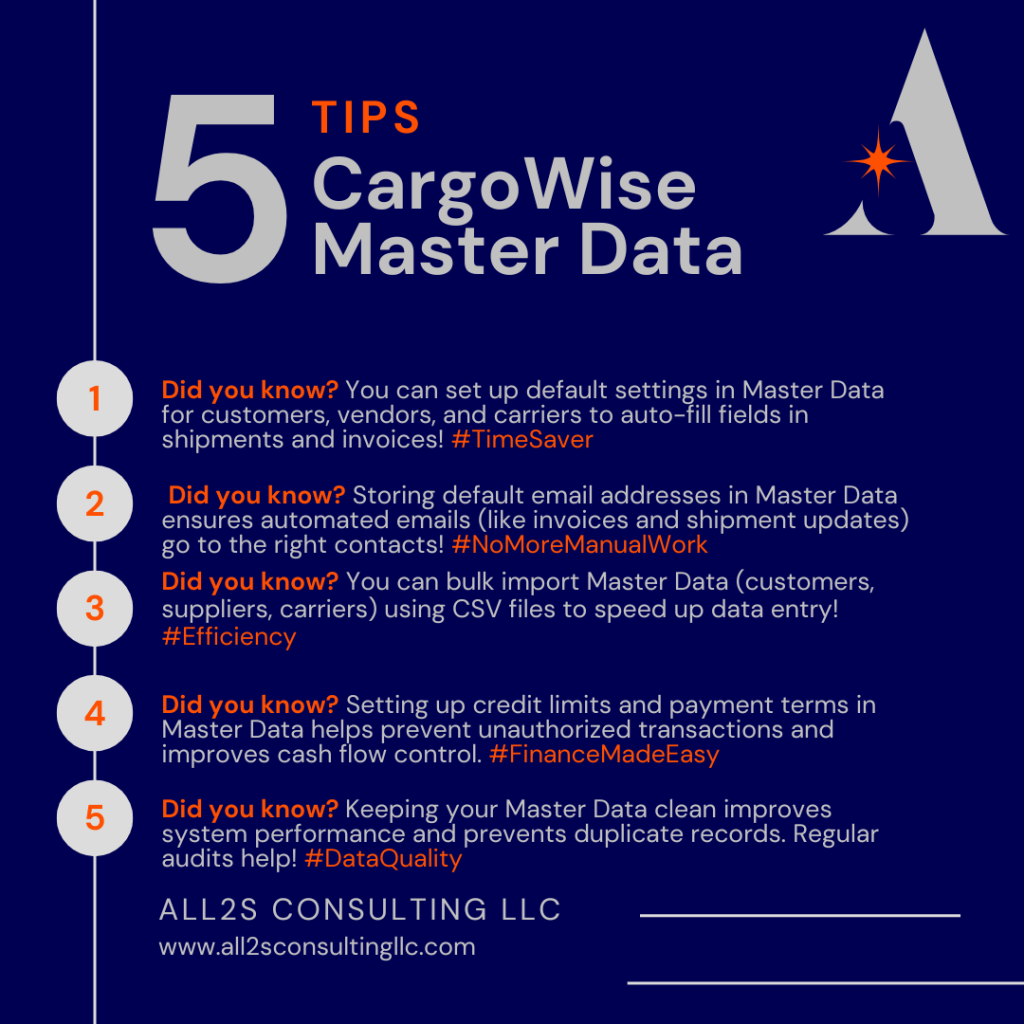
Why does this matter? Because in CargoWise, your master data is the foundation of everything. Automation, workflows, and system-wide integrations all depend on how well-maintained and complete your data is.
🔹 No duplicate organizations 🔹 Complete, accurate, and structured data 🔹 A solid foundation for efficiency
So, now that your organizations are in good shape and you’re ready to pick a solution…
👉 You have options! You can either go with CargoWise’s native solution—using a combination of workflows, milestones, tasks, and triggers—or choose a third-party solution like Raft, Expedock, Cargo Docket, or Carguber to integrate directly into CargoWise.
🚀 How does this help you? Shipments with cost accruals can be automatically matched to vendor invoices, requiring no intervention unless something is wrong.
✨ This means your payables team can shift from manual data entry to high-value tasks like: ✔ Auditing ✔ Managing cash flow ✔ Ensuring financial controls are followed
The number of outliers requiring manual intervention? Just a fraction of what it used to be. 💡
💡 Bonus Tip: You can also streamline and automate your accruals process to further optimize your finance function—allowing your teams to focus on more value-added work instead of chasing numbers. 🚀
Want to explore automation options for your business? Let’s talk! 💬
A structured and compliant vendor onboarding process is critical to avoiding payment delays, fraud risks, and compliance issues. Whether you’re a finance pro, AP specialist, or small business owner, here’s your must-have checklist for new vendor approval and setup:
📌 Step 1: Structured Vendor Setup Request & Approval Process
✔️ Implement a formal vendor setup request form or workflow ➡️ Note: The vendor request process can be a form or a workflow like a ticketing process—I’ve used both. I prefer an electronic ticketing process for efficiency and tracking, but the key is to have a standardized approach that ensures consistency and accountability. ✔️ Require department head and finance approvals before initiating setup ✔️ Clearly define approval criteria (business need, budget, risk assessment) ✔️ Assign responsibilities to ensure checks and balances in the process
🔍 Step 2: Vendor Documentation Collection
✔️ Completed vendor application form ✔️ W-9 (US vendors) / W-8BEN (foreign vendors) for tax compliance ✔️ Business license, insurance certificates (if required) ✔️ NDA or contract agreement (if applicable)
🚨 Important:Payment verification should be conducted separately from vendor setup to prevent fraud. ✔️ Independently verify banking details (e.g., call a known contact, verify letterhead, use secure portals) ✔️ Confirm payment instructions with a secondary source ✔️ Require a test transaction (if necessary) before approving full payments
💻 Step 4: Vendor Setup in the System
✔️ Assign unique vendor ID in accounting system ✔️ Input tax details and payment terms ✔️ Set up approval workflows and payment methods (only after independent verification!) ✔️ Include payment instructions and collected documents (e.g., W-9 or W-8BEN) as permanent records for audit and compliance
✅ Step 5: Final Compliance & Communication
✔️ Ensure all required approvals are obtained ✔️ Notify internal stakeholders (procurement, finance, operations) ✔️ Provide vendor with payment schedule & policies
🎯 Bonus Step: Don’t Be Afraid to Reject a Request!
🚨 Not every vendor request should be approved. If something doesn’t add up, if the information is incomplete, or if there are already too many vendors of the same type—question it. If necessary, reject it. ✔️ Ensure accuracy before approval—cutting corners leads to compliance risks ✔️ Push back when necessary—AP is not just a data-entry function, it’s a financial control ✔️ Fraud prevention starts with vendor scrutiny—if a request seems suspicious, investigate further
⚡ If you’re falling short on this checklist, I can help! ⚡ 📩 Contact me for a free consultation—let’s optimize your vendor setup and AP processes. 💡 ALL2S Consulting LLC—helping businesses streamline, document, and improve financial operations.
🔽 Save & Share this checklist with your team to enhance your AP workflow!
Your payables processes can either protect your business or cost you dearly—and not just in inefficiencies. If your automation is weak, your segregation of duties is lax, or your vendor payments are a mess, you’re exposing yourself to major risks:
🚨 Fraud: 86% of U.S. companies have reported at least one successful payment fraud attack. 💸 Financial loss: 36% of those companies lost over $1 million per incident. Yes, ONE. MILLION. DOLLARS. 😡 Vendor frustration: Late or incorrect payments damage relationships with your most important suppliers.
🔎 Now, let’s talk risk exposure:
How good is your team at reviewing invoices and spotting altered or fraudulent invoices?
How about email requests asking to change payment instructions?
How strong is your validation process before approving changes?
Because here’s the truth—fraudsters are getting more sophisticated. With the rise of AI-driven scams, if you aren’t actively strengthening your defenses, you’re leaving yourself dangerously exposed.
My friend, I can help.
At ALL2S Consulting LLC, we don’t just check the boxes on compliance—we dig deep to make sure your processes are airtight, your team is trained, and your business is protected from costly mistakes.
Let’s talk before you find yourself explaining a million-dollar mistake.
Thank you to everyone who participated in my recent CargoWise training survey—your feedback was invaluable! Based on your responses, I’m thrilled to announce the launch of The ALL2S Advantage YouTube channel!
We’ll be specializing in short, actionable training videos covering: ✅ CargoWise tips & tricks ✅ Industry best practices ✅ Efficiency hacks to streamline your workflows
🔔 Want to be the first to access new videos? Subscribe now and be at the front of the line as we release new content!
🎥 What’s Free & What’s Premium? Our basic training videos will be free to help you master the fundamentals. But if you need one-on-one consulting, Q&A Session, or private training, I’m happy to set up a personalized session—just reach out!






 ALL2S CONSULTING LLC